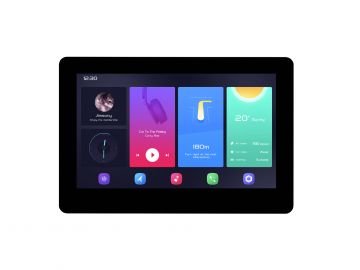
An ESP32-S3 development board pairing a 4.3" 800x480 capacitive touch display with CAN bus, RS-485, optocoupler-isolated I/O, and Li-Po battery management -- all on one compact PCB.
The Waveshare ESP32-S3-Touch-LCD-4.3 (Type B) is an integrated development board that combines Espressif’s ESP32-S3-WROOM-1-N16R8 module with a 4.3-inch IPS capacitive touchscreen and a rich set of industrial-grade interfaces. At its core sits a dual-core Xtensa LX7 processor running at 240 MHz, backed by 16 MB of flash storage and 8 MB of octal PSRAM — enough headroom for complex graphical interfaces built with LVGL or other embedded UI frameworks. The display itself delivers 800x480 resolution at 65K colors with 550 cd/m² brightness and wide 160-degree viewing angles, while the GT911 touch controller provides responsive 5-point capacitive input through toughened glass.
What distinguishes the Type B variant from the standard model is a set of additions aimed at industrial deployment. A wide-range DC input accepts 7 to 36 volts, making the board suitable for 12V and 24V field installations without external regulators. An onboard PCF85063A real-time clock maintains accurate timekeeping across power cycles. Optocoupler-isolated digital inputs accept 5 to 36 volts, and isolated outputs can sink up to 450 mA — both managed through the CH422G I/O expander over I2C. These isolated channels allow the board to interface directly with industrial sensors, relays, and actuators without risking the ESP32-S3 itself.
Communication options include a CAN bus interface through the TJA1051T transceiver (supporting CAN 2.0 via the ESP32-S3’s built-in TWAI peripheral), an RS-485 half-duplex serial link via the SP3485 transceiver, and an SD card slot for local data logging. Dual USB Type-C ports serve programming (via CH343P UART bridge) and USB Host/OTG functions respectively, while an MX1.25 connector supports Li-Po battery charging through the CS8501 boost/charge IC. The result is a self-contained platform for HMI panels, industrial controllers, data loggers, and embedded UI applications that would otherwise require multiple separate boards.
800x480 IPS panel with 550 cd/m² brightness, 160-degree viewing angles, and 65K color depth. The GT911 controller delivers 5-point capacitive touch through toughened glass, providing responsive multi-touch input for embedded UI frameworks like LVGL.
ESP32-S3 Dual-Core
The ESP32-S3-WROOM-1-N16R8 module provides dual Xtensa LX7 cores at 240 MHz, 16 MB flash, 8 MB OPI PSRAM, WiFi 802.11 b/g/n, and Bluetooth 5.0 LE. Enough processing power and memory for complex graphical interfaces and wireless connectivity.
CAN Bus
TJA1051T transceiver connected to the ESP32-S3’s native TWAI peripheral for CAN 2.0 communication. An onboard DIP switch enables or disables the 120-ohm termination resistor, allowing proper bus termination at end nodes.
RS-485 Serial
SP3485 transceiver providing half-duplex RS-485 communication over UART. Like the CAN interface, a DIP switch controls the 120-ohm termination resistor. Screw terminals on the board edge simplify field wiring.
Wide Voltage Input
The Type B variant accepts 7 to 36 volts DC input, suitable for 12V and 24V industrial power rails. The CS8501 boost/charge IC simultaneously powers the board and charges a connected Li-Po battery, enabling uninterrupted operation during power transitions.
Isolated I/O
Optocoupler-isolated digital inputs accept 5 to 36 volts for safe interfacing with industrial signals. Isolated outputs can sink up to 450 mA for driving relays or indicator lamps. The CH422G I2C expander manages these channels alongside display backlight, touch reset, and other board-level control signals.
The display subsystem uses a 16-bit RGB565 parallel interface driven by the ST7262 controller, which handles framebuffer-to-panel conversion while the ESP32-S3 manages pixel data in PSRAM. The GT911 touch controller and CH422G I/O expander share the I2C bus — the CH422G plays a central role on this board, managing backlight enable, touch reset, SD card chip select, and USB multiplexer control in addition to the isolated I/O channels. Communication interfaces connect through their respective transceivers (TJA1051T for CAN, SP3485 for RS-485) to screw terminals along the board edge, while the PCF85063A RTC also sits on the shared I2C bus. Power management routes through the CS8501 for battery charging and boost conversion, with separate 3.3V regulation for the ESP32-S3 module and display circuitry.